
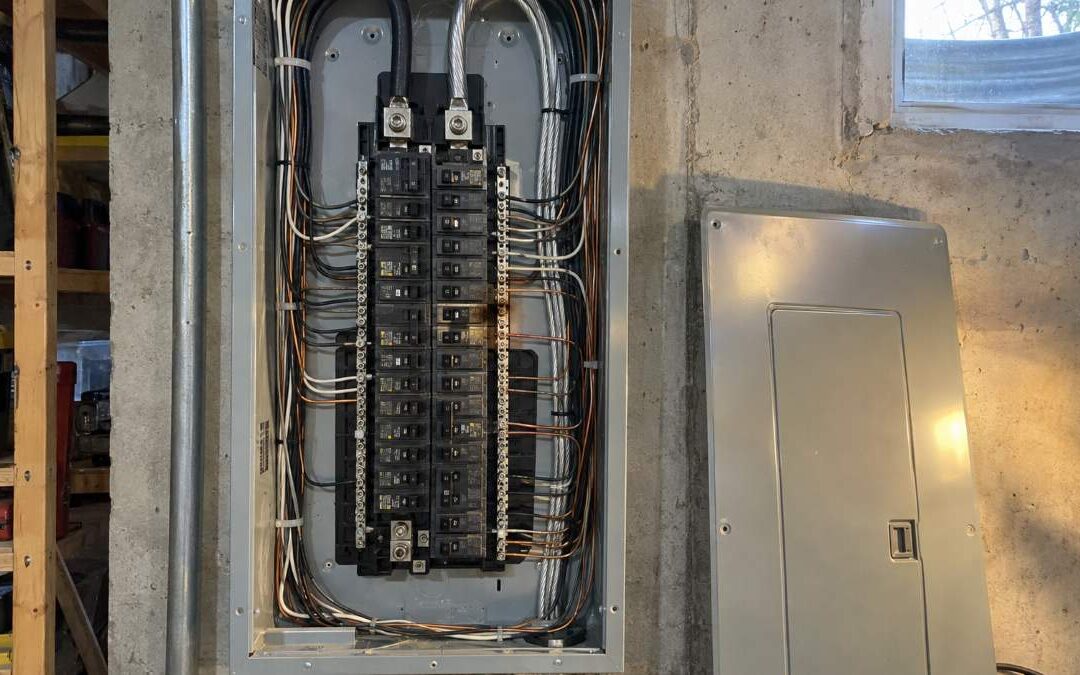
Electrical panel warning signs are the observable signals that a home’s service panel is failing, overloaded, or built on a defective design. One tells you a lot on its own. A cover that is too hot to keep a hand on, or warm when little in the house is running, points to a loose connection inside generating heat through resistance.
Electrical distribution and lighting equipment ranks among the leading causes of US home fires, averaging 32,620 home fires a year from 2015 to 2019, with 430 deaths and about $1.3 billion in property damage annually, according to NFPA. The service panel is where every branch circuit in the house is either protected or left exposed. That is why the signals matter.
This guide explains what each warning sign means, why it happens, and when a symptom crosses from a routine repair into a panel replacement decision for a home in St. Louis City, St. Louis County, or St. Charles County.
What Are the Warning Signs Your Electrical Panel Is Failing?
The clearest warning signs of a failing electrical panel fall into three groups: breakers that trip repeatedly, burning smells or scorch marks at the panel, and a panel that runs warm, buzzes, or crackles. Each points to a different underlying fault.
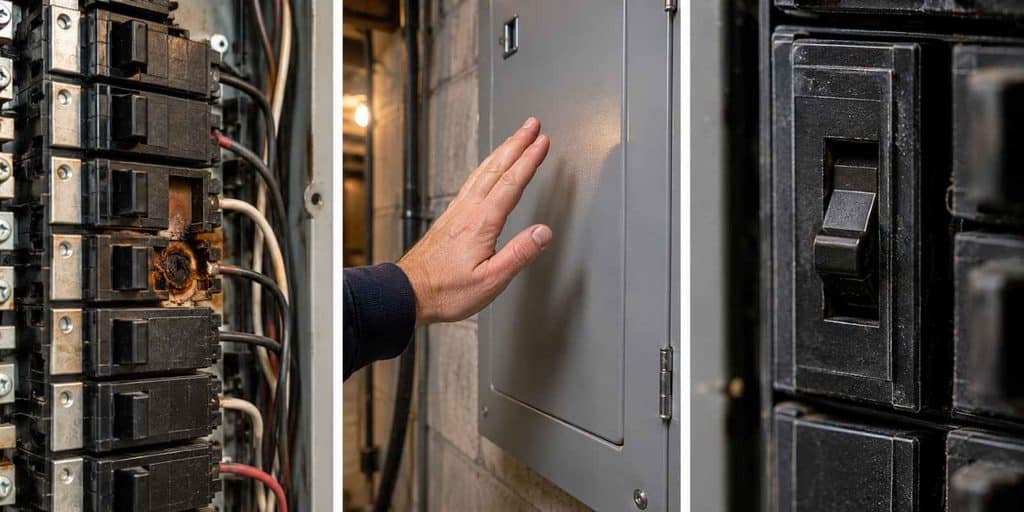
- Repeated tripping. Breakers that keep tripping, especially across more than one circuit, point to a capacity or connection problem rather than one bad appliance.
- Burning smell or scorch marks. An acrid odor, browning, or scorching at the panel signals conductors or connections overheating, and it is the most urgent of the three.
- Heat, buzzing, or crackling. A panel that is warm to the touch or makes a steady buzz or intermittent crackle points to loose connections or arcing inside the enclosure.
Why Do My Circuit Breakers Keep Tripping?
Breakers trip repeatedly when a circuit draws more current than it is rated for, but tripping that continues after you unplug loads points to an overloaded panel, a failing breaker, or a loose connection that needs a licensed evaluation. A one-off trip is the breaker working.
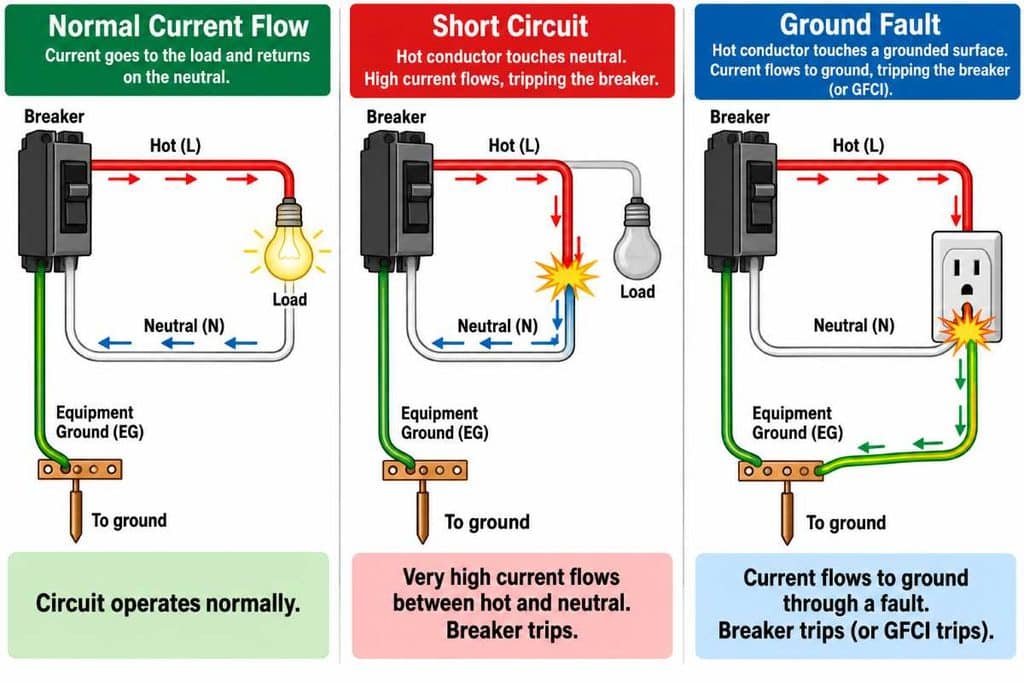
A breaker trips for one of three reasons, each measured against its amperage rating. An overload is the common one: too many devices pulling more current than the circuit is rated for, which heats the breaker’s internal strip until it opens.
The other two are faults. A short circuit is faster and harder, hot and neutral touching directly and bypassing the load, which spikes the current and trips the breaker instantly. A ground fault is current escaping to a grounded path instead of returning on the neutral.
Tripping on a single circuit usually traces to that circuit. Tripping across several circuits, or tripping that persists after the load drops, points to the panel: a loose bus connection, a worn breaker, or undersized service.
Repeated panel-wide tripping is a diagnosis, not a reset.
What Do Burning Smells or Scorch Marks at the Panel Mean?
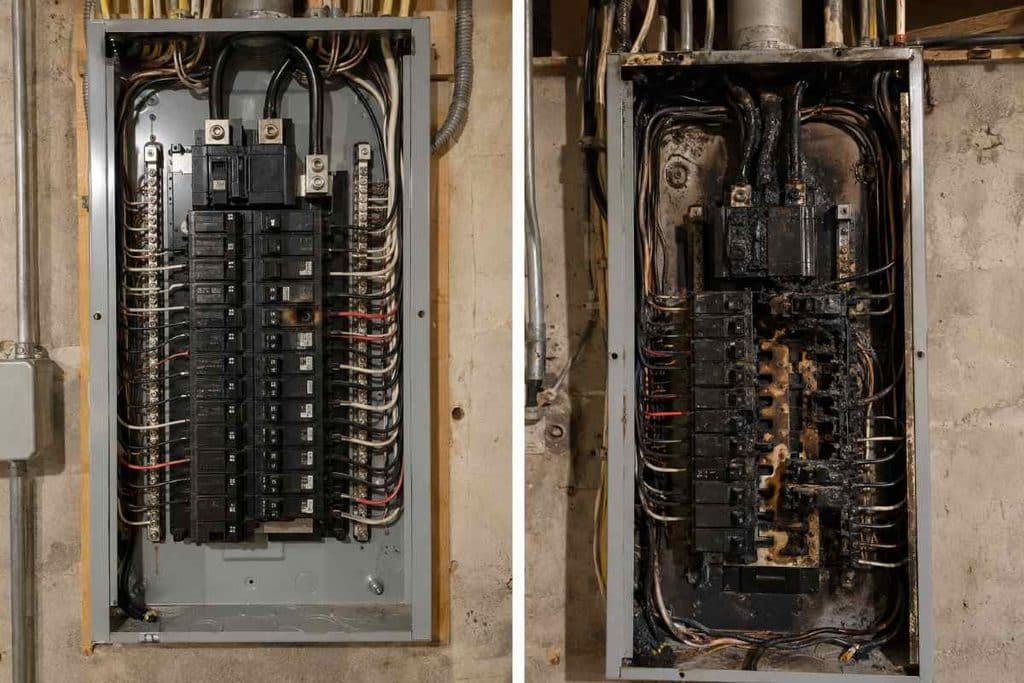
A burning or acrid smell, browning, or scorch marks at the panel almost always mean conductors or connections are overheating, and the panel should be de-energized by a licensed electrician before use continues. This is not a wait-and-see symptom.
The heat comes from a bad connection. When a lug or a breaker seat sits loose, current meets resistance at that point, and resistance turns into heat right where the metal is loose. That heat builds until it softens and chars the insulation around it.
The smell tells you which stage it has reached. A sharp melted-plastic odor means insulation is breaking down from heat; a metallic or ozone-like smell means current is arcing across a gap. Do not open the cover to look. The bus bars and breaker handles can stay energized with the main off, so the fix is an electrician, not an inspection you run yourself.
Why Is My Electrical Panel Warm, Buzzing, or Crackling?
A faint, steady hum from a panel is normal, but a louder buzz, or crackling and sizzling, points to arcing at a loose connection or a failing breaker and needs prompt evaluation. The sound is the tell.
That baseline hum is just alternating current vibrating the metal inside the box, usually faint enough that you notice it only with your ear close. What matters is change. A buzz that grows louder when the air conditioner or another large load kicks on has moved past that hum into a connection working loose under the heat of each cycle.
Crackling, sizzling, or popping is a different category. Those sounds are current arcing across a gap at a lug or a worn breaker, and arcing runs hot enough to char insulation. Note when the sound happens and what is running, then call an electrician. Do not open the cover to chase it.
When Is a Panel Too Small for a Modern St. Louis Home?
A panel is undersized when the household routinely trips breakers running normal appliances, relies on power strips for fixed loads, or still runs a fuse box or 60-amp service, which sits below the 100-amp minimum the NEC sets for a one-family dwelling. Capacity is the question here, not a single bad circuit.
The floor is fixed. A one-family home’s main service disconnect has to be rated for at least 100 amperes, 3-wire, the minimum set by NEC 230.79(C).
That 100-amp number is a floor, not a target. The code also requires the disconnect to meet the home’s calculated load under Article 220, so a house with heavy demand needs more than the minimum. A panel at or below 100 amps is not automatically a violation, but it is the point where capacity starts to constrain what the home can run.
The Field Signs of an Undersized Service
The clearest signs are behavioral and physical, not a number on the panel door. A home built around a fuse box or a 60-amp service was wired for a smaller electrical era, and it shows in daily use.
- A fuse box or a 60-amp service, common in older St. Louis housing wired before modern loads.
- Breakers that trip running ordinary appliances, a microwave and a toaster on the same circuit.
- Power strips carrying fixed loads because there are not enough circuits to go around.
- No headroom to run two large appliances, an oven and a dryer, at the same time.
Two hundred amps is the modern baseline for a service upgrade, and the reason is load, not fashion. A Level 2 EV charger and a heat pump each draw heavily and continuously, and stacking them on an older service is what pushes a home from tight to undersized. The panel is not failing. It is outmatched by what the house now asks of it.
What Hidden Problems Show Up Inside an Aging Panel?
Inside an aging panel, the common hidden hazards are aluminum branch wiring, double-tapped breakers, and ungrounded two-prong circuits, and their fire and shock risk rises with panel age even when the panel looks fine from outside. These are not things you can spot from the cover.
An electrician finds them by opening the panel and tracing connections, which a homeowner cannot do. The panel door hides every termination behind it, and the outside of the box stays clean and cool while a connection degrades inside:
- Aluminum branch wiring, which expands and oxidizes at every termination, loosening connections and raising resistance until they overheat.
- Double-tapped breakers, two conductors jammed under one lug that was designed for a single wire, so one runs loose and arcs.
- Two-prong ungrounded circuits, wiring with no equipment ground, which leaves no safe path for a fault and raises shock risk.
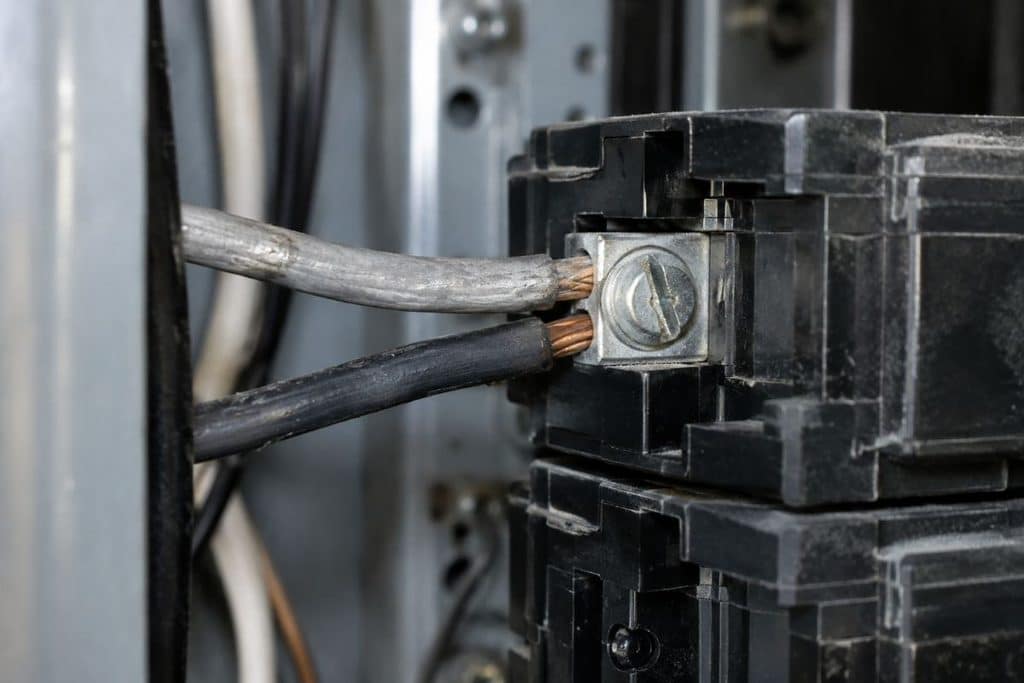
Each of these can sit behind a panel door that looks completely ordinary. The danger is not in how the panel looks. It is in how the connections behind it have aged.
Why the Risk Climbs With Age
Age is the multiplier on every one of these defects, because the failure mechanism is cumulative. Aluminum does the most telling damage. Each heating and cooling cycle loosens a connection a little more, and oxidation builds a resistive layer that turns current into heat right at the termination.
The connection does not fail all at once. It degrades over decades, which is why an old panel can pass a glance and still be unsafe inside.
The scale of that risk is measurable. Homes built before 1972 with aluminum branch wiring are 55 times more likely to have a connection at an outlet reach the point where it chars surrounding material or sparks, compared with copper-wired homes, according to the CPSC.
Most panels themselves run 25 to 40 years before their components are past their service life. A panel near or beyond that window is not automatically unsafe. It is just old enough that what is inside deserves a look.
Which Electrical Panel Brands Are Documented Fire Hazards?
Federal Pacific Electric Stab-Lok and Zinsco panels, the latter also sold as GTE-Sylvania, are the two designs with documented, testing-backed failure modes, and both should be replaced rather than repaired breaker by breaker. The danger with both is a breaker that does not trip when it should.
You can identify a Federal Pacific panel by the Stab-Lok name on the panel label or on the breaker faces, and by the distinctive thin breaker handles, often with a red stripe or marker, set behind the deadfront cover. The brand went into homes from the 1950s into the 1980s. If your panel says Stab-Lok, that is the one to have evaluated.
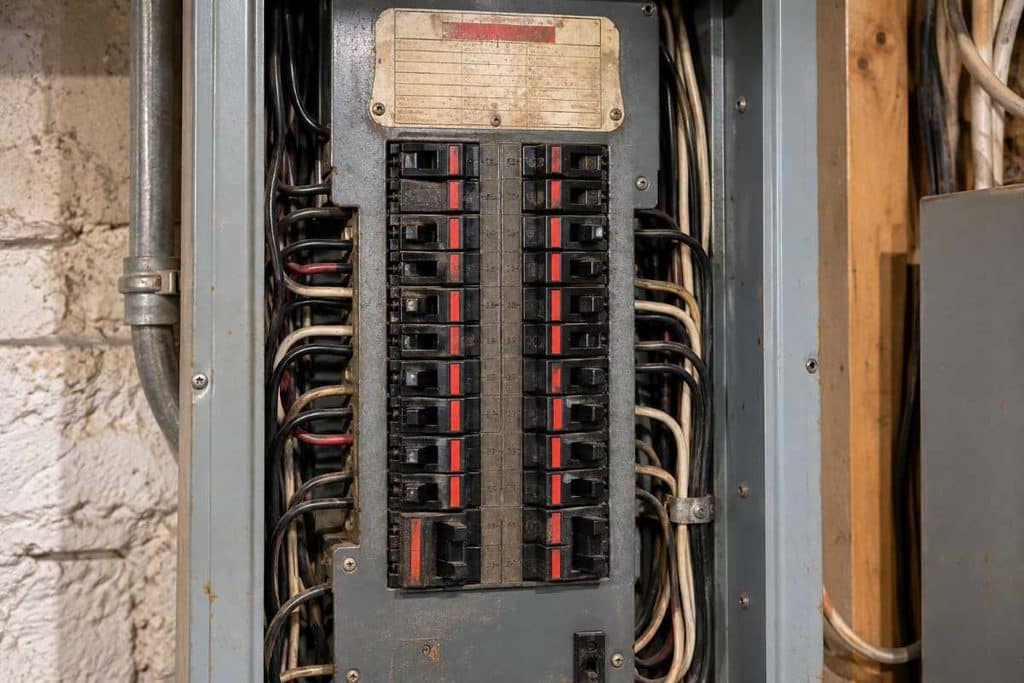
The record against these breakers is specific. In calibration testing, two-pole Stab-Lok breakers failed to trip at 135 percent of their rated load about a quarter of the time, and the rate rose after normal switch use, a failure the CPSC confirmed in its own testing. The breakers did not meet the UL 489 calibration standard that every residential breaker is required to pass. The CPSC closed its investigation in 1983 without a recall, citing the cost of proving the risk, not a finding that the breakers were safe.
That closure has not aged well. A Stab-Lok panel that looks intact can still hold breakers that will not trip in a fault.
You can identify a Zinsco or GTE-Sylvania panel by those names on the label, by the colored breaker handles, often red, blue, or green, and by the way the breakers clip onto the bus from the side behind the deadfront. Sylvania continued the Zinsco design after acquiring it, so a GTE-Sylvania panel of that lineage carries the same flaw. The label is the tell.
The failure is in the bus bar itself. Zinsco breakers clip onto an aluminum bus, and over decades that aluminum oxidizes and overheats through cold flow, the slow deformation of the soft metal under pressure and heat. The breaker can weld to the bus, so the handle moves to off while the circuit stays live.
A welded bus connection is why swapping breakers does not fix a Zinsco panel. The defect is the bus, not the breaker, so the only reliable remedy is full panel replacement,
What Does St. Louis Code Require for a Panel Upgrade?
A panel upgrade in the St. Louis area is a permitted job that must be done by a licensed electrical contractor. Where the 2023 National Electrical Code is the adopted edition, replacing the service equipment also triggers whole-home surge protection and an outdoor emergency disconnect for one- and two-family dwellings.
Every panel or service-equipment upgrade in the area shares a baseline set of requirements, regardless of which code edition your jurisdiction is on. Some attach to every job, and two attach only when the service equipment itself is replaced, which is the distinction that decides what your project owes. The list below separates the two:
- A pulled permit, filed with the jurisdiction before the work begins.
- Work performed by a licensed Missouri electrical contractor, not a handyman or the homeowner.
- Whole-home surge protection, when the service equipment itself is being replaced.
- An outdoor emergency disconnect for one- and two-family dwellings, under the applicable edition.
The contractor coordinates the permit, the inspection, and the utility disconnect and reconnect with Ameren. None of that falls to the homeowner.
The Code Basis and What Triggers It
Two requirements attach specifically when service equipment is replaced, and both live in the National Electrical Code. A home replacing its service equipment gains whole-home surge protection at the panel, a Type 1 or Type 2 surge protective device required under NEC 230.67.
It also gains an outdoor emergency disconnect for one- and two-family dwellings, required under NEC 230.85. The point is first-responder safety. A disconnect lets them cut power from outside the house.
Whether a job triggers those two requirements depends on scope and on the local inspector. A full service-equipment replacement brings them into play, while work limited to the meter can fall under an exception. The AHJ makes that call locally. So the identical panel job can owe a surge device and an outdoor disconnect in one municipality and not in the next one over.
Which edition is in force is the part to confirm for your own address. Confirm the current edition with your building division before treating either requirement as mandatory for your project.
Should You Repair the Panel or Replace It, and What Do You Do Next?
Repair is appropriate for an isolated fault, such as one failed breaker on an otherwise sound panel, while replacement is required when the signs are systemic: a hazard-brand panel, a damaged bus bar, an undersized service, or persistent overheating. The line between the two is whether the problem is one part or the panel itself.
| Repair the fault | Replace the panel |
|---|---|
| One breaker that fails but the panel is otherwise sound | A hazard-brand panel (Federal Pacific or Zinsco) |
| A single loose connection corrected on inspection | A burned bus stab, where a new breaker won’t fix it because the bus it clips to is the damaged part |
| An isolated tripping circuit traced to one appliance | An undersized service that trips under normal use |
| A cover or knockout replaced | Persistent heat, odor, or scorching at the panel |
What to Do Next
If there is heat, a burning smell, or scorching at the panel, stop using the affected circuit and leave the panel closed. Do not open the cover to look. The bus and breaker handles can stay energized even with the main off, so a visual check is not something to do yourself.
The next step is an inspection by a licensed electrician, where an electrician tests the panel and runs a load calculation to size the service to the home. That is how a repair-or-replace call gets made on evidence instead of a guess.