
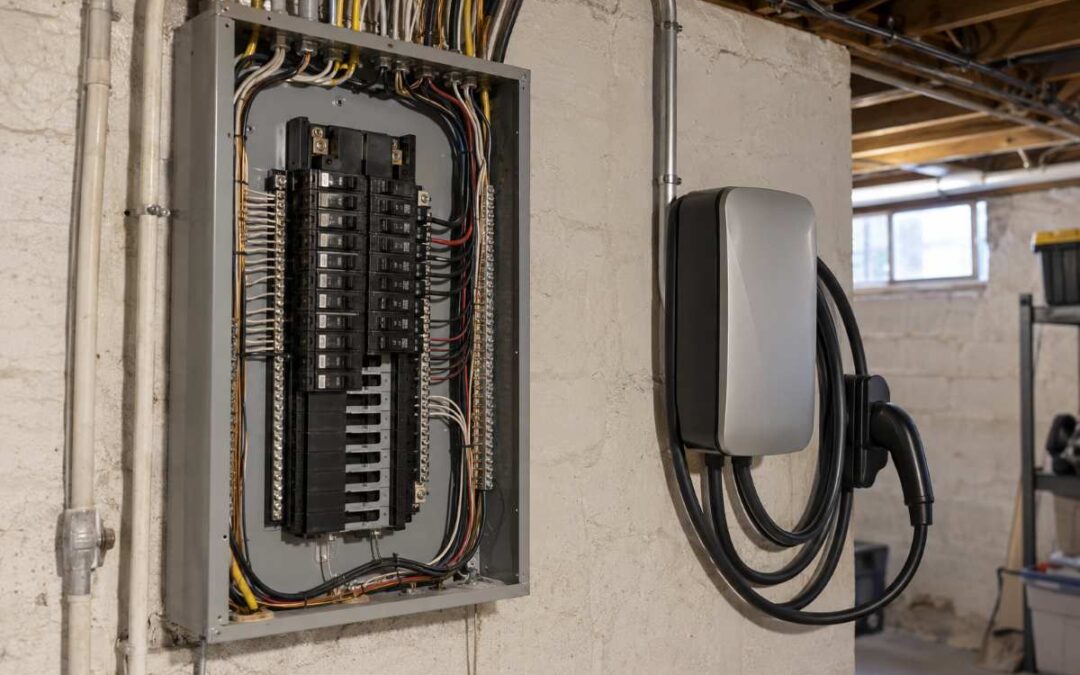
EV charger panel capacity is the spare electrical capacity in a home’s service and panel that a Level 2 charger can draw on. A Level 2 charger runs on a 240 volt circuit, the same class as an electric range or dryer. Homeowners arrive with two questions. Can my panel carry the charger, and what does it cost to add capacity if it cannot.
The answer turns on a load calculation, not on the number stamped on the panel. The label is not the answer. A load calculation totals what the home already draws, mostly its big appliances, and adds the charger. A 100 amp home on gas heat and a gas range often passes where an all-electric 200 amp home does not.
That calculation also sets most of the cost. It decides whether the work is a simple circuit or a full panel or service upgrade.
Pure Home Electric installs these circuits across St. Louis City, St. Louis County, and St. Charles County, often in older homes and detached garages where the existing service is the real constraint. This guide covers what the charger needs, how the calculation works, and what each path costs.
What Does a Level 2 EV Charger Need From Your Panel?
Start with the car, not the charger on the shelf. The vehicle’s onboard charger caps how much current it will actually pull, that rating fixes the breaker and wire size, and the breaker decides whether the unit plugs in or gets hardwired. Those three choices, in that order, are what claim space on your panel.
Does Your EV Limit How Many Amps the Charger Can Use?
Yes, and it is the first number to check. A car’s onboard charger, the unit inside the vehicle that converts AC power for the battery, caps how much current the car will pull. A car that accepts 32 amps gains nothing from a 48 amp charger on a 60 amp circuit. You find that ceiling on the vehicle’s spec sheet, listed as the AC charging rate in kilowatts.
The car sets the ceiling, not the charger. Divide that kilowatt figure by 240 volts to get amps: 7.68 kW comes out to 32 amps, and 11.52 kW to 48 amps. The Tesla Wall Connector tops out at 48 amps, but a 32 amp car driving it still draws only 32.
Sizing the charger to the car frees real capacity. A 32 amp charger adds 7,680 VA to your panel; a 48 amp unit adds 11,520 VA. The smaller match leaves more room for everything else the house runs.
What Size Breaker Does a 40 Amp EV Charger Need?
A 40 amp EV charger needs a 50 amp breaker. The charger runs continuously while the car charges, so the code sizes its circuit at 125 percent of the charger’s rating, which puts a 40 amp unit on a 50 amp breaker (NEC 625.41).
That continuous-load classification, set in NEC 625.42, is also where the trade’s “80 percent rule” comes from: a charger is only allowed to draw 80 percent of its breaker, which is the same 125 percent math read backward. The table gives the breaker, copper wire, and panel load for the four common charger ratings.
| Charger rating | Breaker | Copper conductor | Continuous load (VA at 240V) | Connection |
|---|---|---|---|---|
| 24 A | 30 A | 10 AWG | 5,760 VA | Plug-in (NEMA 14-50) or hardwired |
| 32 A | 40 A | 8 AWG | 7,680 VA | Plug-in (NEMA 14-50) or hardwired |
| 40 A | 50 A | 6 AWG | 9,600 VA | Plug-in (NEMA 14-50) or hardwired |
| 48 A | 60 A | 6 AWG | 11,520 VA | Hardwired only |
Should a Level 2 EV Charger Be Plug-In or Hardwired?
A charger rated 40 amps or less can plug into a NEMA 14-50 receptacle on its own 50 amp circuit, while a 48 amp charger has to be hardwired on a 60 amp circuit. The reason is the outlet itself. A NEMA 14-50 is rated for 50 amps, so it cannot legally sit on the 60 amp circuit a 48 amp charger requires.
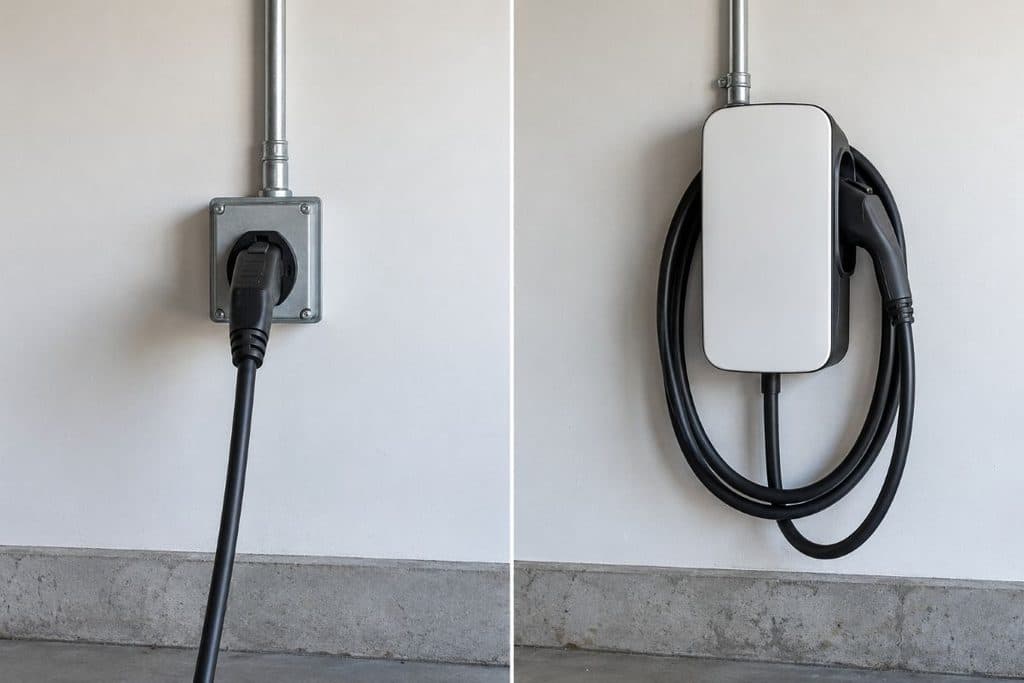
Either way, the charger gets its own branch circuit. Under NEC 625.40, an EV charger drawing more than 16 amps must run on an individual branch circuit that serves nothing else, unless an energy management system is holding down the load.
Homeowners ask about the dryer outlet. A 30 amp dryer circuit can run a charger within limits, because it is already an individual branch circuit sized for a 240 volt load. The 125 percent rule caps a portable charger on that dryer circuit at 24 amps, since 30 divided by 1.25 is 24.
Two conditions decide whether a dryer outlet is usable. Where the adopted code edition requires it, the receptacle needs ground-fault protection for personnel under NEC 625.54, confirmed in the 2023 edition. Running both appliances off one outlet through an adapter adds a second outlet to a circuit the code wants dedicated, which is the inspector’s call.
That setting has a speed cost. At 24 amps the charger delivers about 5.76 kW, roughly half a 48 amp unit.
What Electrical Code Does St. Louis Use for EV Chargers?
St. Louis has no single electrical code. Each authority having jurisdiction, the local office that issues permits and inspects the work, adopts its own edition of the National Electrical Code. The rule your inspector applies depends on which city or county the house sits in, not on the metro as a whole.
As of October 2026, the City of St. Louis enforces the 2017 NEC, adopted under Ordinance 70802. O’Fallon, St. Charles County, and Lake Saint Louis each enforce the 2020 NEC. O’Fallon has been on that edition since January 1, 2025, and Lake Saint Louis since March 1, 2024.
None of these verified jurisdictions uses the 2023 edition some contractors quote. Editions change on their own schedule, so the one in force can shift after this page is written.
Which edition applies matters because the EV rules differ between them. The exterior emergency disconnect under NEC 230.85 first appears in the 2020 edition, so a 2017 jurisdiction like the City does not require it. The 2023 edition adds a load-calculation floor for chargers under NEC 220.57 and bars the charger from a demand factor earlier editions allowed.
Pure Home Electric confirms the adopted edition when it pulls the permit for the address. One jurisdiction is left open here on purpose. St. Louis County’s edition is not stated until it is verified against the County’s own code.
How Is an EV Charger Counted in a Panel Load Calculation?
An EV charger enters the load calculation at its nameplate rating, 9,600 VA for a 40 amp unit, and the adopted code edition decides the rest. Under the 2017 and 2020 editions, that nameplate VA is the number. The charger can also sit among the fastened-in-place appliances sharing a 75 percent demand factor when four or more are present, under NEC 220.53.
The 2023 edition sets a load floor under NEC 220.57, counting the charger as the greater of 7,200 VA or its nameplate. That floor equals 30 amps at 240 volts, so it only raises chargers rated under 30 amps. A 40 or 48 amp unit already clears it, and the 2023 edition also bars EV equipment from the 220.53 demand factor. Which edition your inspector enforces decides which rule applies.

The standard calculation adds up everything the house draws against the service rating. The electrician records the service size, the nameplate ratings of fixed appliances like the range, dryer, and water heater, plus the heating, cooling, and general lighting loads. Heating and air conditioning rarely run at once, so the calculation drops the smaller of two such loads under NEC 220.60. The charger is added on top.
The calculated demand is then set against the service rating. Whatever is left is the charger’s headroom.
For an existing home, two methods often fit a charger where the standard calculation says it will not. The existing-dwelling method under NEC 220.83 counts the first 8 kVA of load at 100 percent and the remainder at 40 percent, then adds the larger of heat or air conditioning. That discount matters. It drops a lot of connected load the house never runs at once.
The measured-demand method under NEC 220.87 works from real usage. It takes the highest demand the home pulled over a full year, multiplies it by 125 percent, and adds the new charger. A 30-day metered load study is allowed when a year of data is not available. A 100 amp house that fails the nameplate math can pass on how it behaves.
Can a 100 Amp Panel Handle a Level 2 EV Charger?
A 100 amp service can carry a Level 2 charger when the load calculation, with the charger included, stays at or under the service limit. A 100 amp service at 240 volts is 24,000 VA. A 40 amp charger adds 9,600 VA and a 48 amp charger adds 11,520 VA, so a 48 amp unit claims 48 percent of the service before any demand factors.
What fills the rest is the house.
The appliance fuel mix decides it. Take a 100 amp home with gas heat, a gas range, and a gas water heater, with only the dryer and general loads on electricity. After the existing-dwelling demand factors, that home often lands well under 24,000 VA with room for a 40 amp charger. Swap in electric heat, an electric range, and an electric water heater, and the same house can exceed 24,000 VA before the charger is added.
Age is why this comes up so often here. The median St. Louis city home was built in 1938, so a large share of the city’s houses sit on service sized for a mid-century load, not an EV.
A second check is the panel itself, not just the math. The amperage stamped on the main breaker and the label on the panel tell you the service size and the manufacturer. Two manufacturers change the answer on sight. Federal Pacific Stab-Lok breakers have a documented tendency to fail UL calibration tests for tripping, and Zinsco breakers can fuse to the bus bar, so both are insurance-flagged and replaced rather than repaired.
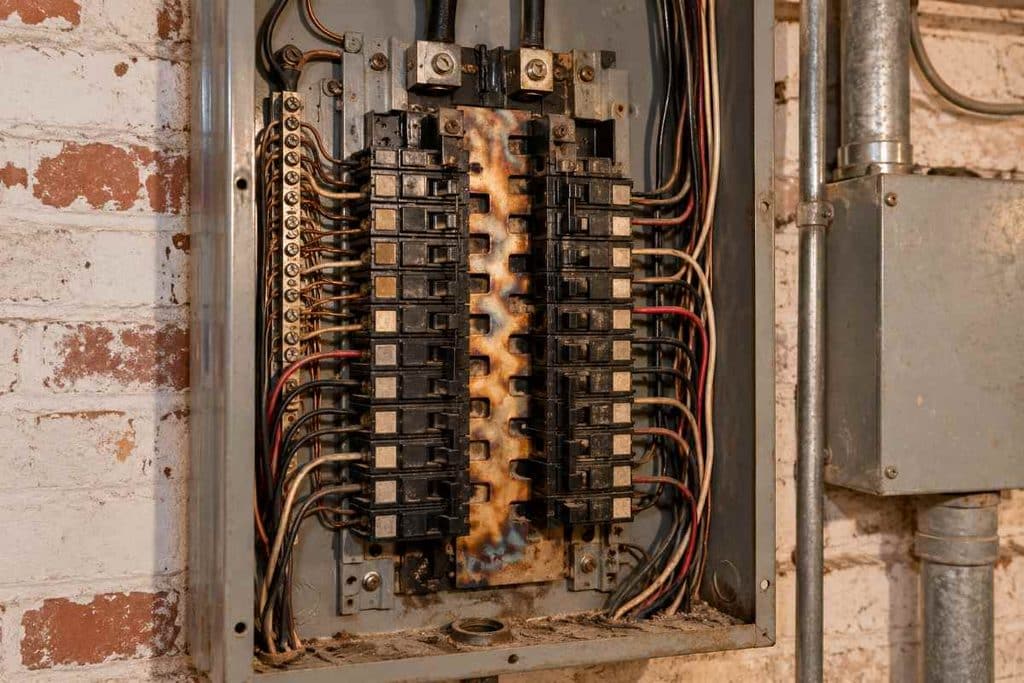
A hazard-brand panel overrides the arithmetic. The panel is replaced whether or not the calculation leaves room, and whether that replacement becomes a full service upgrade is the decision covered later on this page.
The garage is the last place the capacity can run out. On a detached garage, an existing feeder or subpanel can be the real bottleneck before the main panel is, because it was sized for lights and an outlet, not a 40 amp charger. Pure Home Electric installs 60, 100, and 125 amp subpanels depending on what the garage has to carry.
Distance drives the rest. The longer the run from the house to the garage, the larger the feeder conductor and the more trench the job needs.
What Are the Options When Your Panel Is Too Small?
When the calculation fails, you have two directions. You can manage the load so the charger draws less, with a lower amperage setting or an energy management system, or you can add capacity by replacing the panel or upgrading the service. Managed options cost less and limit speed; added capacity costs more and leaves room for future loads.
The table compares the four paths. To test whether a managed setting still covers your driving, divide your daily miles by the setting’s output: a 24 amp setting delivers 5.76 kW, and a typical EV uses roughly a quarter to two thirds of a kWh per mile.
| Option | What changes | Effect on service capacity | Charging speed | Code basis | Ameren involved |
|---|---|---|---|---|---|
| Lower amperage setting | Charger set to a fixed lower current | Charger counts at the adjusted current | Reduced; 24A gives 5.76 kW | Restricted-access adjustable settings rated at the adjusted current (NEC 625.42(B)) | No |
| Energy management system (EMS) | Device caps the charger’s draw dynamically | Service and feeder load is the maximum the EMS permits | Varies with household demand | EMS sets the permitted maximum load (NEC 625.42(A)) | No |
| Panel replacement, same rating | New panel, same service amperage | No capacity gained; fixes space or condition | Unchanged | Replacement triggers the emergency disconnect where adopted (230.85) | Usually not |
| Service upgrade, higher rating | Higher-amperage service entrance | Raises the service rating | Full, within the new rating | Emergency disconnect and SPD on replaced service equipment, by edition (230.85, NEC 230.67) | Yes, disconnect and meter set |
What Happens During an EV Charger Panel or Service Upgrade?
A panel or service upgrade runs in six steps, from the load calculation to the moment power comes back on. You lose power only on the service-upgrade path, and only during a scheduled Ameren disconnect; a circuit-only install never cuts the home’s power.
Pure Home Electric handles the survey, the permit, and the inspection scheduling in-house, so the homeowner does not deal with the jurisdiction or the utility directly.
- Run the load calculation and site survey to size the work.
- Put the scope and price in writing before anything starts.
- File the electrical permit with the authority having jurisdiction.
- Install the panel, service equipment, or circuit.
- Pass the authority having jurisdiction inspection.
- For a service upgrade, Ameren Missouri disconnects, the meter is set, and power is restored.
The permit is what triggers the inspection, and the inspection is what makes the work count. Work done without a permit stays uninspected, and that gap surfaces later at resale or in an insurance claim.
The utility side has a fixed line of responsibility. Ameren Missouri owns the service drop, and the homeowner owns everything from the weatherhead down, including the meter socket and the service-entrance conductors. Ameren sets the meter after the inspection passes, not before. Power returns at the end of the sequence, not the middle.
Should You Upgrade the Panel or Manage the Charger Load?
Manage the load when the calculation passes at a reduced setting that still covers your daily miles and no new electric loads are planned. Upgrade when the panel is a hazard brand or full, when the calculation fails at the charger size your car can actually use, or when a planned heat pump, induction range, or second EV will not fit.
Four conditions point to a service upgrade, and any one of them is enough.
- A Federal Pacific Stab-Lok or Zinsco panel, which is replaced rather than repaired.
- No open spaces left for the charger’s two-pole breaker.
- The load calculation fails at the charger size your car can use, even at its lowest setting that still covers daily miles.
- A planned heat pump, induction range, or second EV that will not fit within a 100 amp service.
Four conditions point the other way, toward managing the load.
- The calculation passes once the charger is set to a lower amperage.
- That reduced setting still recovers your daily miles overnight, as a 24 amp setting at 5.76 kW does for most commutes.
- Your car’s onboard charger does not need a 48 amp circuit in the first place.
- The panel has open spaces and is not a hazard brand.
The two paths meet on 200 amp service, which is 48,000 VA. A heat pump and a charger fit together there when the existing-dwelling calculation stays under that figure, with heating and cooling at full value and the charger among the other loads at the 8 kVA and 40 percent factors. That headroom is the real reason to upgrade. It plans for the next load, not just this one.
Why the Load Calculation Decides, Not the Panel Label
The number on the panel is where most people start. It is the wrong place to look. Whether a home can carry a Level 2 charger comes down to a load calculation that weighs what the house already draws against the service rating, and the appliance fuel mix moves that result more than the amp label does.
A 100 amp home on gas can often take a charger a larger all-electric home cannot. That is the real question before any work begins: not how big the panel is, but what the calculation shows once the charger is in it.
The answer decides the path. It sets whether the job is a simple circuit, a managed setting, or added capacity, and that last split is where the cost really moves: the home that needs no new capacity pays a fraction of the one that needs a service upgrade. For how the dedicated circuit is run once the capacity is confirmed, the circuit installation covers the connection itself.