
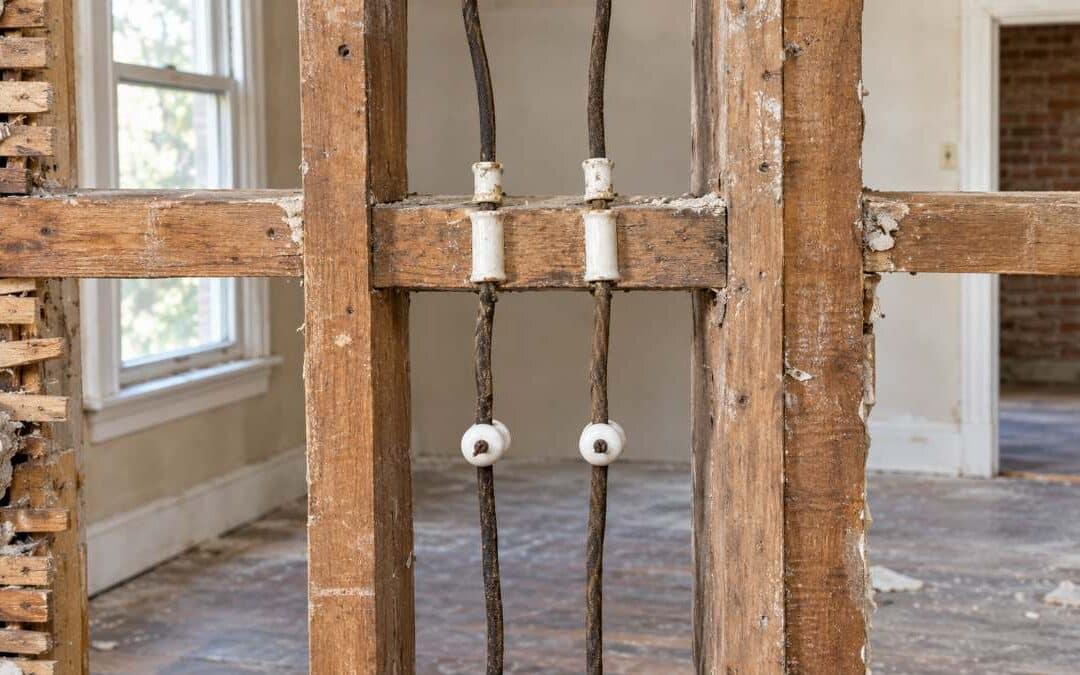
Knob-and-tube wiring is the single-wire electrical system in many houses built before the mid-1900s, named for the porcelain knobs that hold each wire off the framing and the tubes that carry it through joists and studs. What you have, if it is in your home, is a two-wire system: hot and neutral run separately, and no third wire carries a fault safely to ground.
Maybe you found it in a basement. Maybe an inspection or an insurance review flagged it. That design leans on open air around each wire to shed heat, so packing building insulation against it traps that heat and turns an energy upgrade into a fire risk.
Knowing what it is comes before knowing what to do about it. How does the system work, how does it fail, and how do you confirm it is in your walls? What do the code and your insurer expect once you know?
The one most people arrive with is the last: keep it, partly replace it, or rewire. Start with what it is.
What Is Knob-and-Tube Wiring?
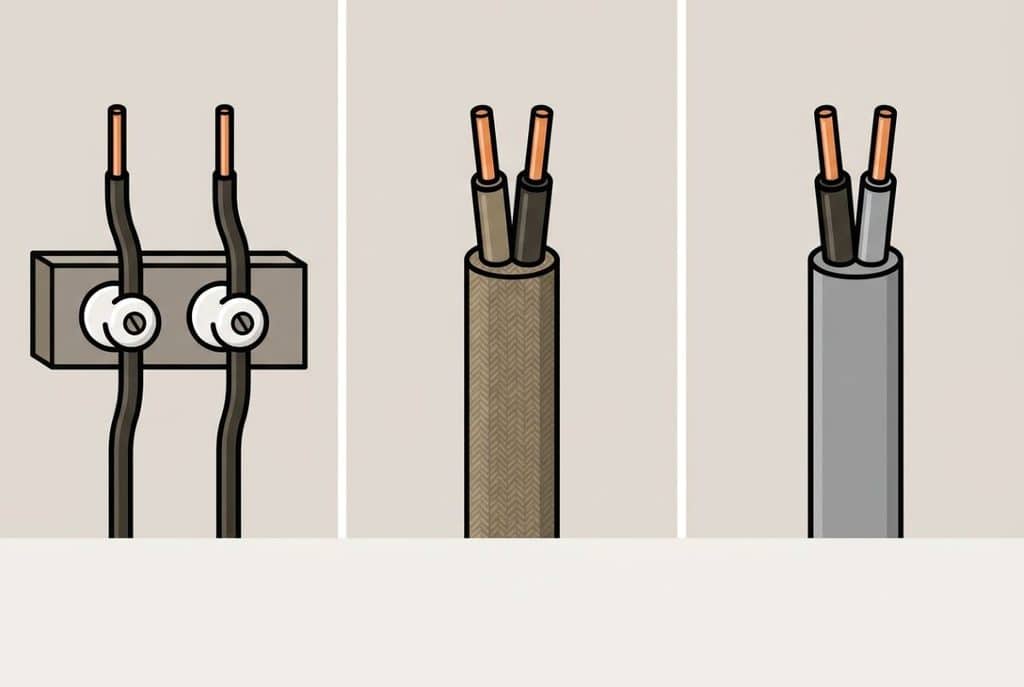
Knob-and-tube wiring is an early two-wire system that runs separate hot and neutral copper conductors on porcelain knobs and through porcelain tubes, with no ground wire and open air around each conductor to shed heat. Two other wiring types found in older homes, cloth-insulated cable and ungrounded two-wire cable, keep both conductors inside one jacket instead.
The parts are simple, and you can usually spot them. Single insulated copper conductors are fastened to porcelain knobs nailed along the joists and studs, and they pass through the framing inside porcelain tubes. Where a wire reaches a box or a fixture, a sleeve of flexible nonmetallic loom protects it.
Hot and neutral do not travel together. Because they run on separate paths, one can stay live when its partner is cut, so a loose K&T wire is never read as dead until an electrician confirms it. The system also carries no equipment grounding conductor, the third wire that would give a fault a safe path back.
Among the wiring a homeowner meets in an older house, this was typically the first installed, ahead of the cable types. Cloth-insulated cable is the easiest to tell apart: its conductors run together inside a single woven jacket, not spaced apart on knobs.
The later ungrounded two-prong circuits also run in cable, bundled the same way and still with no ground. Knob-and-tube is the only one of the three built from separate single conductors on porcelain supports. One more distinction matters when you identify it: the version hidden inside finished walls and ceilings is concealed knob-and-tube, while the same knob-supported method run out in the open on framing is open wiring on insulators
How Does Knob-and-Tube Wiring Work?
Knob-and-tube wiring works by keeping each conductor separated and held off the framing, so the heat from current flow escapes into open air. Fuses protect each circuit, splices are soldered and taped in open air, and no conductor carries a ground.
The separation is the whole idea. The hot and neutral run apart and stand off the wood on their knobs, so each sheds its heat into the air instead of into anything that can burn. That cooling carries the wire’s rated current safely, but only while the air space stays open and the insulation stays intact.
Overcurrent protection sits at a fuse panel. Many original panels fused both the hot and the neutral. If that neutral fuse blows, the circuit reads dead while its hot wire stays live. That is why a K&T circuit which looks off is not assumed dead until an electrician confirms it.
What the system never had is a safety ground. With no equipment grounding conductor, the third wire that carries a fault back to the panel, a short to a metal fixture or appliance case has nowhere to go. The metal stays energized, and the fuse may never sense the fault.
How Do You Know If You Have Knob-and-Tube Wiring?
You likely have knob-and-tube wiring if exposed joists in an unfinished basement or attic show white porcelain knobs and tubes carrying single wires spaced apart. Wiring hidden in finished walls can only be confirmed, and checked for whether it is still live, by a licensed electrician’s inspection.
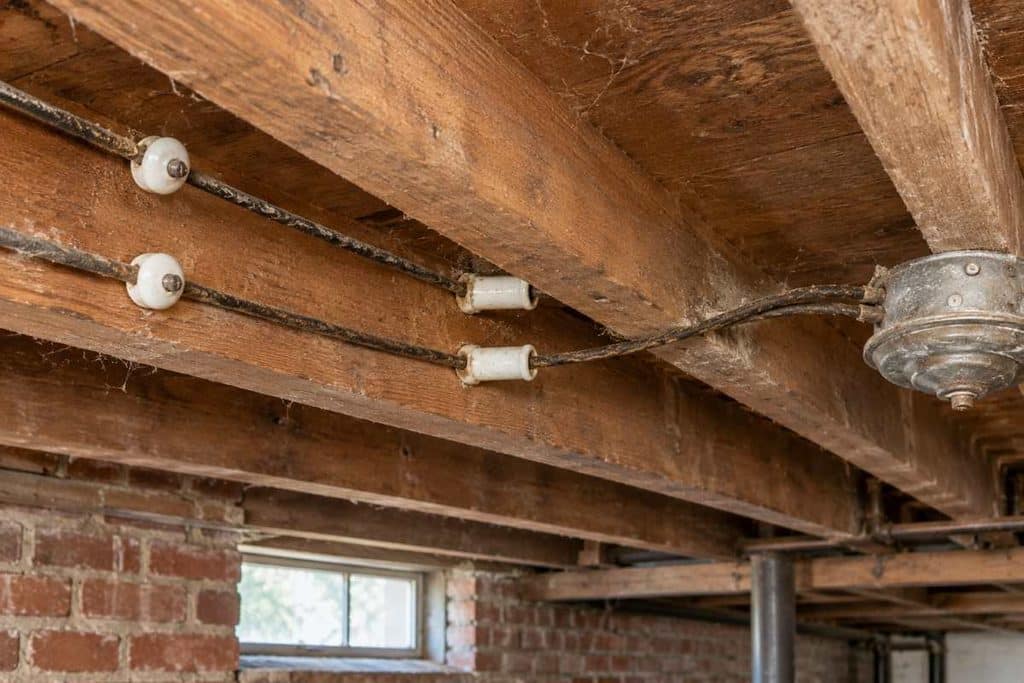
Start where the framing is already open, in an unfinished basement or attic, and look for these visible signs:
- Porcelain knobs nailed to the sides of joists or studs, each holding a single wire off the wood
- Porcelain tubes running through bored holes in the joists, with a wire passing inside
- Two single conductors running parallel and spaced several inches apart, not bundled together in one cable
- A woven cloth sleeve, usually black, brown, or faded gray, where a conductor enters a ceiling fixture box
Look only. Do not touch the wires, move insulation to see behind them, or open a box or fixture, because any tool or hand near a live conductor is a licensed electrician’s work, not a homeowner’s.
Some signs show up without ever seeing the wiring. Two-prong receptacles, an old fuse panel instead of a breaker panel, and a flag in an inspection report all point the same way. Three-prong outlets do not rule it out, because a past owner can swap one in without ever adding a ground. None confirms K&T alone, and none shows whether a run is still live or abandoned.
Only a licensed electrical contractor’s evaluation settles both. What you can safely do beforehand is note which rooms have two-prong outlets and which circuits trip, so that evaluation starts with a map.
Why Does Knob-and-Tube Wiring Become a Fire Risk?
Knob-and-tube wiring becomes a fire risk in three ways. Its conductor insulation cracks with age, later work splices or extends it without boxes, or a fuse larger than the wire’s rating lets the conductor overheat. Unmodified K&T in sound condition carries less risk than K&T that has been altered or overloaded.
Three failure modes drive almost all of it:
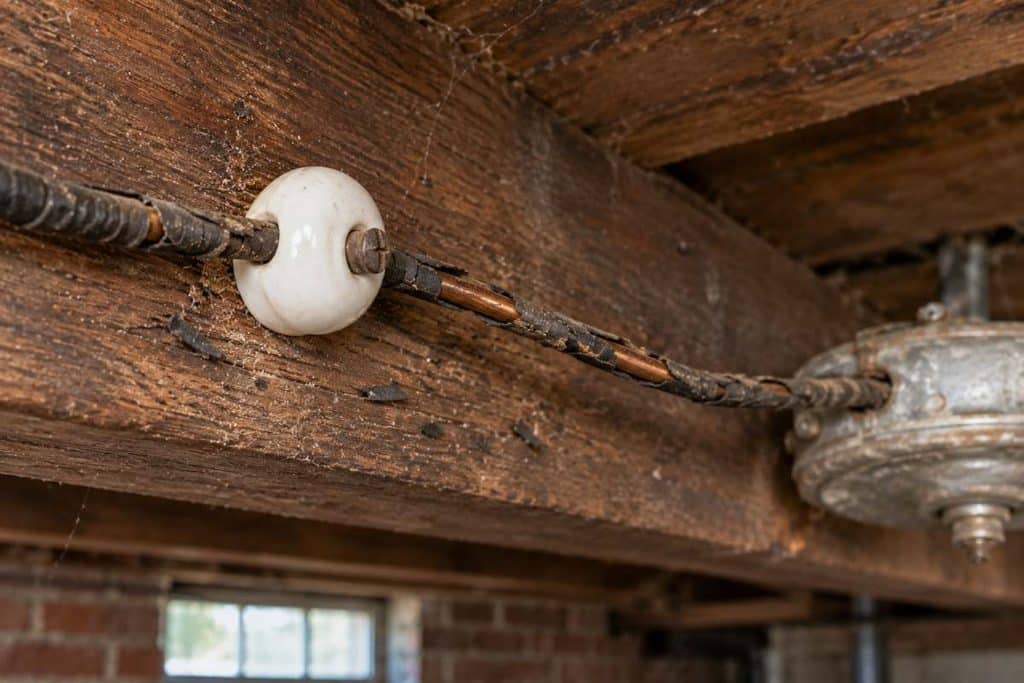
- Aging conductor insulation: the rubber and cloth wrap dries out, cracks, and falls away, leaving bare copper at knobs, tubes, and fixture boxes
- Improper modifications: splices to newer cable made outside a junction box, extensions added onto old runs, and runs closed into a wall during a remodel
- Overfusing: a fuse rated above what the wire can carry, so the conductor overheats before the fuse ever opens
The first is about age and heat. Decades of warmth, worst at the ceiling light fixtures where heat pools, dry the insulation until it crumbles and bares the conductor. That is also the honest answer to how long knob-and-tube lasts: it has no fixed service life. Fixture heat, past modifications, and insulation packed against it all shorten it, so condition, not years, is what matters.
The other two come from what people did to it later. A splice that ties old K&T into modern cable outside a box, or an extension added onto an existing run, puts the connection most likely to overheat where nothing contains an arc. A run closed into a wall during a remodel hides the same risk.
Overfusing adds the rest. A fuse too large for the wire lets the conductor run hot before it trips, and once the insulation is cooked, the hazard stays even after the right fuse goes in. Matching the fuse to the conductor, and judging whether a run is sound, is a licensed electrician’s call, and the panel is their work, not a homeowner’s.
Can You Put Insulation Over Knob-and-Tube Wiring?
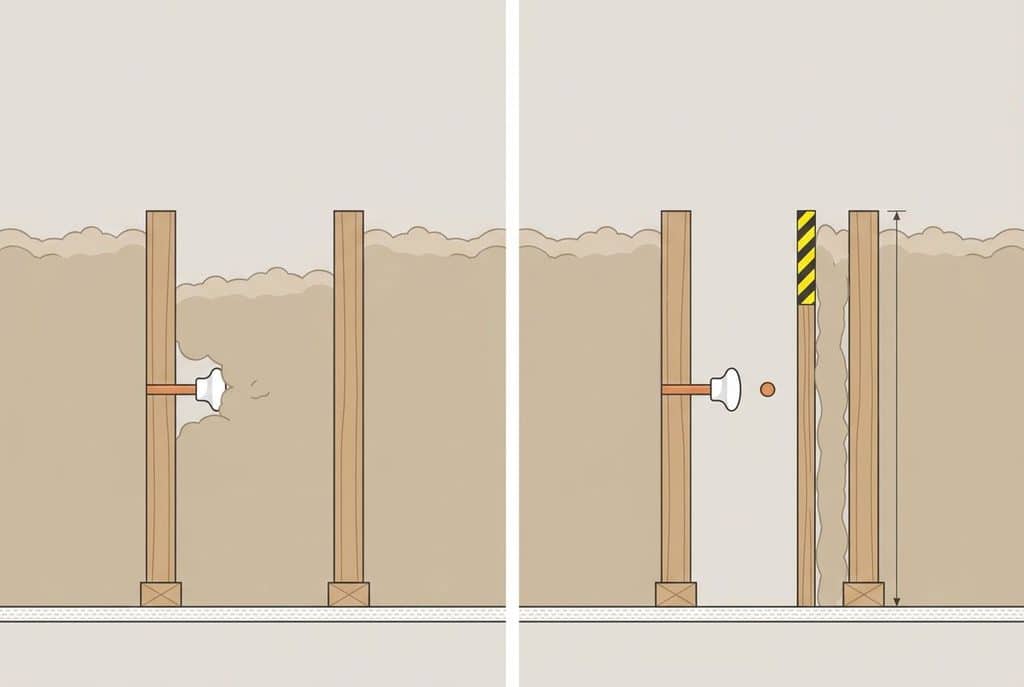
You should not let loose-fill, batt, or spray foam insulation surround live knob-and-tube wiring, because the insulation traps the heat the conductors are designed to release into open air. Under federal weatherization specifications, the installer keeps insulation out of any area with energized knob-and-tube and holds at least 3 inches of clearance around live runs that stay.
The reason is the free-air design that made K&T work in the first place. Each conductor sheds its heat into the open space around it. When loose-fill, rolled batt, or foamed-in-place insulation packs against the wire, that heat has nowhere to go and the conductor runs hot.
For that reason the electrical code restricts concealed knob-and-tube in hollow spaces filled with insulation that surrounds the conductors. A run that was safe in open framing becomes a fire risk once it is buried.
On a home weatherized under a federal program, this is handled by spec, not guesswork. The Department of Energy’s Weatherization Assistance Program requires its work to meet the Standard Work Specifications where they apply. Those specifications treat energized knob-and-tube as a stop.
Before an installer lays attic floor or knee wall insulation, the installer verifies that the area is free of energized knob-and-tube wiring. Any live run that stays gets isolated rather than covered.
The installer holds a minimum of 3 inches of clearance around any live knob-and-tube that stays. The run is marked with caution tape visible from at least 5 feet, and signage is posted. That keeps the next person from burying it.
The Department of Energy’s attic floor job aid goes further: check for live knob-and-tube, then dam it off where possible or replace it with modern wiring. De-energizing or replacing a run is a licensed electrician’s work, not the insulation crew’s.
Is Knob-and-Tube Wiring Still Legal?
Homeowners can generally keep existing knob-and-tube wiring in service, but new concealed K&T is limited to extending an existing installation or to work the local building official specially approves. Which code edition governs any work depends on the jurisdiction: the City of St. Louis enforces the 2017 NEC, and St. Charles County enforces the 2020 NEC.
No electrical code forces you to tear out sound, unmodified knob-and-tube. The common belief that K&T is simply “illegal” is wrong. What the code limits is new work: concealed K&T can go in only to extend an existing installation, or where the authority having jurisdiction grants special permission. Legal to keep is a separate question from safe to keep, which depends on the condition yours is actually in.
Touching one circuit does not force a whole-house rewire either. An undisturbed run that stays sound is generally outside a permit’s reach. The section you open up or modify is what gets brought to current code, and the authority having jurisdiction decides where that line falls.
The edition that applies to any work depends on which code your city or county has adopted. In the City of St. Louis, that is the 2017 National Electrical Code, adopted through Ordinance 70802 and listed by the City of St. Louis Building Division as the electrical code in force. K&T work there follows the 2017 edition.
That edition, not a newer one, is the benchmark. A requirement that first appears in a later NEC edition applies in the City only once the City adopts it.
Cross the county line and the edition changes. St. Charles County enforces the 2020 National Electrical Code, adopted in its Electric Code and most recently amended by Ord. No. 25-085. St. Louis County, by contrast, is on its own edition.
A homeowner there confirms that edition with the County before relying on any specific rule. Because every municipality adopts its own code, there is no single metro-wide edition, and no jurisdiction here should be assumed to be on the latest published NEC.
Can You Insure a Home With Knob-and-Tube Wiring?
Many homes with knob-and-tube wiring can be insured, but some insurers decline active K&T, charge more for it, or require an electrician’s written evaluation first. A licensed electrical contractor’s report on which circuits are live, their condition, and any modifications is the document insurers and buyers ask for.
Insurance turns on the condition of the wiring. Underwriting questions usually come back to the same few things: whether any of it is still energized, how much is left, its condition, and the panel type. That first question is the sticking point. A run that looks abandoned still counts as active until an electrician verifies it is disconnected and puts that in writing.
From there, outcomes vary by insurer. One may write the policy as is, another may add a surcharge, and a third may ask for an electrician’s evaluation letter before binding. Some decline active K&T outright, so no single rule fits every company.
A home sale puts the same question in front of a buyer. When a home inspection report flags knob-and-tube, that is a prompt for a licensed electrical contractor’s evaluation, not a verdict on its own.
The evaluation does the sorting. It documents which circuits are live, where the insulation is damaged, what has been spliced, and whether anything touches building insulation, and it gives the buyer and insurer a written scope to act on. If an insurer then says the home must be rewired, that is the insurer’s own decision, not a requirement of the electrical code.
Should You Replace Knob-and-Tube Wiring?
You should plan to replace knob-and-tube wiring under five conditions. Replace it when it touches insulation, when its insulation is brittle, when it has been spliced or extended, when your insurer requires it, or when you are opening walls anyway. Replacement is done under an electrical permit and inspection, and it puts in new grounded circuits rather than patching the old ones.
Each trigger points back to a specific problem. Insulation contact traps the heat the system has to shed, and brittle insulation means bare copper is already showing. Old splices or extensions add the connections most likely to overheat.
An insurer’s requirement is about keeping coverage, and a renovation that already opens the walls is the lowest-disruption moment to pull new wire. Sound, unmodified knob-and-tube that no one has insulated over can stay in service, checked by a licensed electrician from time to time.
Grounded outlets are their own decision inside that. Swapping a two-prong receptacle for a three-prong one with no ground behind it creates a false ground. The outlet looks protected, but it is not.
The code-recognized alternative is GFCI protection on the ungrounded circuit, with the receptacle labeled “No Equipment Ground” so no one mistakes it for a grounded one. That is a licensed electrician’s job, because it is work on the circuit behind the device.
A full replacement is a defined process, not a patch. A licensed electrical contractor pulls the electrical permit, runs new grounded branch circuits, and disconnects the old knob-and-tube. Where it is sealed in, it is left in place; where it can be reached, it is pulled.
The work then passes a local inspection. What that costs and how it is sequenced depends on the home, and belongs in a conversation about the replacement itself.